Blueprints in Rephrased
C++ owns shared gameplay behavior. Blueprints assemble that behavior, assign assets, and drive presentation.
If Blueprint reflection and BlueprintNativeEvent are new, read Blueprints overview.
Current ownership split
| Area | C++ owns | Blueprint owns |
|---|---|---|
| Player | movement, interaction order, native rune coordinator | camera/content references, input assets, HUD class |
| World runes | candidate/pending state, ranges, transaction token | mesh, materials, authored range size, optional visual events |
| Drawing | stroke graph state, exact matching, input bindings | shared pattern data, widget class, visual presentation |
| Rune-responsive objects | noun/status state, rule resolution, command events | noun rules, starting status, State Looks, Performances, part components |
| Puzzle behaviors | URunePuzzleBehavior and the shared behaviors |
picking and tuning behaviors per puzzle; Blueprint behavior subclasses |
| Levels | runtime actor behavior | placement, references, collision, pacing |
Player Blueprint
BP_RephraseCharacter1 is the shipping character Blueprint. It assigns:
IMC_Default- movement, interaction, reset actions
- native
RuneCoordinatorreferences: IMC_RuneDrawing- drawing actions
DA_RuneDrawingGraph- drawing widget class
- command feedback class
- input restore policy
Coordinate ownership before editing this shared binary asset.
World-rune Blueprint
Create a Blueprint child of AWorldRune for each placed word. Assign the word data, visual mesh, glow materials, and authored sphere sizes. C++ manages candidate and pending state; Blueprint events are available for additional feedback.
Behavior Blueprint
A new kind of performance can be a Blueprint child of URunePuzzleBehavior. Implement OnBegin, OnUpdate, and OnComplete; it then appears in every puzzle's Behavior dropdown. Create a C++ behavior when it needs native logic or save support.
Puzzle Blueprint
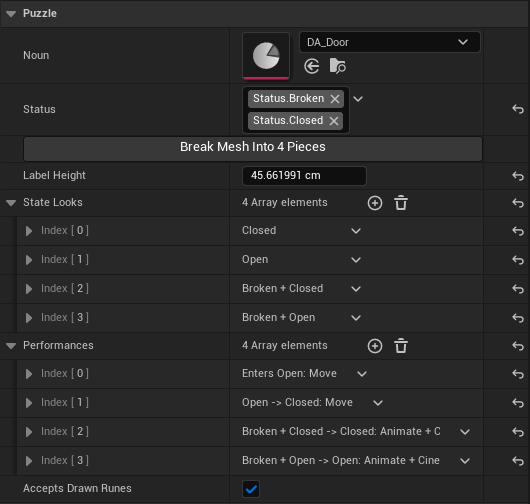
Every puzzle device Blueprint derives from ARunePuzzleActor. Configure:
- Noun and starting Status on
RuneableObject - State Looks: one row per state
- Performances: what plays on each result: Animate to Look, Play Cinematic, and an optional Behavior. A Play Cinematic row's Cinematic Sequence is a Level Sequence Actor in the level, so it is set on the placed puzzle
- Part components: every part of the puzzle is a component of the Blueprint; the looks and performances pick them by name
- Accepts Drawn Runes
Source files
Source/Rephrased/RephraseCharacter.hSource/Rephrased/RuneSystem/Activation/WorldRune.hSource/Rephrased/RuneSystem/Activation/RuneCoordinatorComponent.hSource/Rephrased/RuneSystem/Effects/RunePuzzleActor.hSource/Rephrased/RuneSystem/Behaviors/RunePuzzleBehavior.h
Change history
- 2026-10-02 — Gabriel Li — The Cinematic Sequence is part of the performance that plays it and is set on the placed puzzle; Performances list Animate to Look, Play Cinematic, and Behavior; added editor screenshots (CORE-011).
- 2026-10-01 — Gabriel Li — Replaced Linked Actors with part components and a Cinematic Sequence (CORE-011).
- 2026-09-29 — Gabriel Li — Puzzle and behavior Blueprints follow noun rules, State Looks, and Performances (CORE-009).
- 2026-09-17 — Gabriel Li — Updated Blueprint ownership for the shipping player, world runes, drawing, status effects, and Door/Light puzzle actors.
- 2026-05-23 — Gabriel Li — Split Rephrased-specific Blueprint rules from generic overview.
- 2026-05-08 — Gabriel Li — Added baseline change history section for weekly wiki maintenance.